

There is a growing conversation spreading across marketing circles: GEO and SEO are not the same things, and traditional optimization won’t be enough in the age of generative AI engines. Industry experts claim SEO is becoming outdated as platforms like Perplexity, ChatGPT, Gemini, and Search Generative Experience (SGE) rewrite how users discover information. But it’s hard to ignore how much GEO still depends on the same foundations that built SEO in the first place.
So, rather than accept or dismiss the claim, let’s dig into how traditional SEO compares to GEO — and whether they are actually competitors or simply two sides of the same evolving search landscape.
The Claim: GEO Isn’t SEO — Two Disciplines, Two Outcomes
Advocates for Generative Engine Optimization argue that the systems we are optimizing for now are fundamentally different. Search engines like Google evaluate indexed content algorithmically, while generative engines use large-language models that synthesize entire answers. From that view, optimizing for one shouldn’t apply to the other. Yet, businesses still rely on discoverability, credibility, and visibility across both channels — which makes separation difficult in practice.
In reality, users bounce between AI-chat result summaries, direct answers, classic SERPs, and trusted websites. It is impossible to divide real behavior into “SEO buckets” and “GEO buckets” because users don’t consume content that way.
Why GEO Is Being Treated as a Separate Discipline
-
- AI engines extract answers instead of ranking URLs
- Queries produce paragraphs, not clickable lists
- Content can earn visibility without SERP ranking
- GEO focuses on model training, not indexing
- New platforms (Perplexity, SGE) rewrite discovery
- Perception: SEO plays defense, GEO plays offense
SEO: The Foundation of Discoverability for Index-Based Search
Traditional SEO is built on ensuring content is seen, understood, and trusted by search crawlers. It thrives on keywords, structure, categorization, and authority signals validated through backlinks and user engagement. SEO’s goal is to make a specific page appear higher in results when a user performs a query on an engine like Google or Bing.
SEO also reinforces credibility by demonstrating expertise and topical authority over time. While the mechanisms may shift, the principle stays constant: content must be accessible and valuable to both search engines and humans. If AI tools were suddenly removed tomorrow, SEO would still power billions of daily search decisions.
The Core Mechanics That Drive SEO
- Algorithms rank URLs based on relevance and authority
- Keyword structure and semantic intent guide discovery
- Backlinks validate trust and source authority
- Technical optimization enables crawl and index access
- Content answers explicit search questions
- SEO remains platform-neutral and evergreen
GEO: Content Built for Generative Engines and AI Answer Surfaces
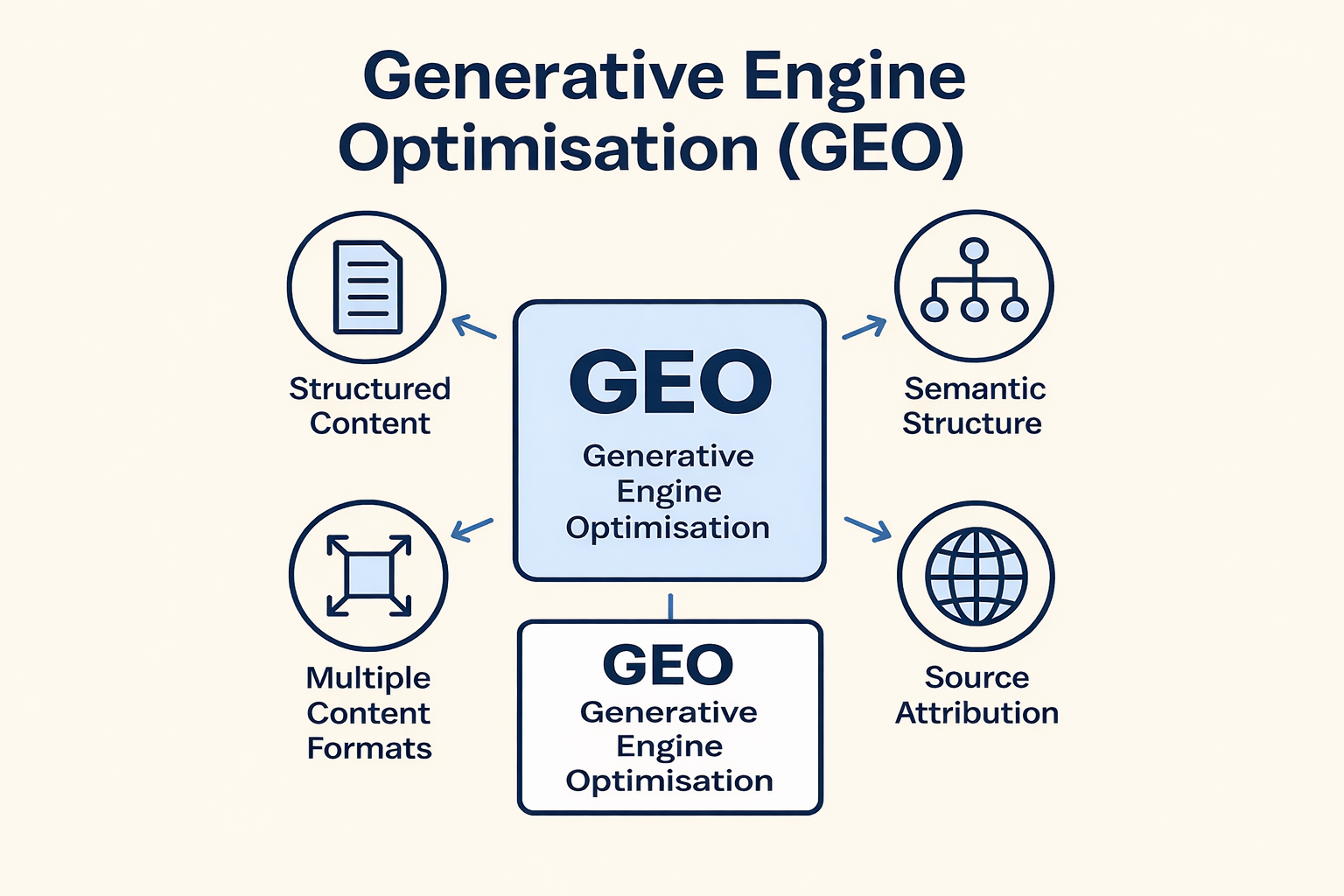
Generative Engine Optimization shifts its attention away from indexed ranking and toward AI-derived results. Instead of competing for a numbered SERP position, GEO targets inclusion within AI-generated summaries, citations, suggested sources, and conversational responses. These engines don’t simply pull text — they infer meaning, evaluate patterns, and combine multiple sources into one synthesized answer.
The opportunity is both massive and challenging. A single GEO win can provide exponential visibility through citations, summaries, and conversational triggers across multiple engines. But GEO also demands new strategies: formatting data for LLMs, structuring knowledge semantically, and demonstrating experience through signals AI engines deem trustworthy.
How GEO Alters the Optimization Playbook
- AI outputs combine multiple sources into one answer
- Content must be model-friendly, not title-friendly
- Structured insights, definitions, and arguments matter
- Entity clarity matters more than keyword counts
- Engines favor expertise-rich sources and verified claims
- GEO improves reach where SERPs weaken
Where SEO and GEO Overlap: The Parts No One Can Actually Separate
Despite claims of separation, GEO runs on the fuel SEO produces. AI cannot generate reliable answers without pulling from well-indexed, credible sources — often the same content optimized for search. The better your content performs in organic search, the more likely it is seen, ingested, and surfaced by LLM-based models.
Models may operate differently than crawlers, but they still need clear language, structured context, trusted sourcing, and real subject expertise. In many ways, GEO doesn’t replace SEO — it uses SEO as its source material, then amplifies it across experience-based interfaces.
Shared Principles That Drive Both Disciplines
- Models rely on trusted, authoritative content
- Strong topical depth fuels generative answer visibility
- E-E-A-T matters in SERPs and AI summaries
- Reputation & citations influence both ecosystems
- Content clarity increases recall by both algorithms and models
- SEO-built assets become GEO inputs
How Generative Engines Decide What Content to Surface
Unlike search engines that return ranked links, generative engines output narrative answers. They select content based on training data exposure, embedding relevance, topic authority, and retrieval systems that combine indexing with inference. Content must appear reliable enough to be cited inside generated text or used silently as a knowledge reference.
This hybrid selection system rewards brands that invest in deep expertise, structured information, and duplicative signals across multiple platforms. LLMs are increasingly augmented with live web retrieval, meaning optimization feeds both the model’s learned patterns and its real-time access.
The Signals AI Engines Lean On
- Entity clarity: brand, author, industry niche
- Citations: explicit mentions on authoritative platforms
- Topical depth: clusters and supporting content
- Evidence: data, firsthand experience, original insight
- Engagement signals: how widely content is referenced
- Credibility layers: authorship, publication history, reputation
Where SEO and GEO Diverge in Day-to-Day Strategy
SEO teams track organic rankings, SERP share, indexed pages, and link-building progress. GEO requires analyzing where your content appears in AI answers, identifying missing model visibility, and developing assets designed for inference rather than indexing. GEO success is less about ranking and more about being chosen as a trusted source by generative models.
SEO focuses on the platform (Google, Bing). GEO focuses on systems (ChatGPT, SGE, Perplexity). Both require content, research, and authority — but execution paths diverge in meaningful ways.
Strategy and Measurement Differences
- SEO measures URL rankings and organic clicks
- GEO measures share-of-answer across AI engines
- SEO leans on keyword → page mapping
- GEO leans on topic → entity recognition
- SEO scores relevance through search algorithms
- GEO wins by shaping model perception and recall
Real Examples That Show the Relationship Between GEO + SEO
Imagine a SaaS company publishing a breakthrough guide to API authentication. With SEO alone, the page could rank for thousands of keyword variations and bring consistent organic traffic. When GEO enters, that same article may start surfacing as a citation in ChatGPT answers, Perplexity summaries, and SGE results — expanding reach without a single SERP click.
Conversely, content designed only for GEO — short insights posted on non-indexed channels or purely conversational interfaces — may never earn authority signals needed for long-term compounding visibility. Together, SEO and GEO enhance each other, but neither can wholly replace the other.

Practical Takeaways From Both Realities
- SEO content can power GEO exposure across engines
- GEO amplification multiplies the ROI of SEO assets
- GEO-only content risks shallow authority
- SEO-only content risks decline as AI adoption grows
- Long-term brands develop both system fluency
- Future winners are multi-surface discoverable
So, Does GEO ≠ SEO?
Technically Yes — Ecosystem Logic Says No.
At a tactical level, GEO and SEO diverge — one optimizes for generative outputs, the other for ranked links. But dismissing SEO in favor of GEO ignores the fact that generative engines must consume, learn from, and reference something. The very knowledge layer powering AI exists because of SEO-optimized content.
GEO is not replacing SEO — it is expanding the playing field. The strongest marketers will stop asking which one matters and start building strategies that feed both search algorithms and generative reasoning systems simultaneously.
FAQS
What is Generative Engine Optimisation (GEO)?
GEO is the practice of shaping content so it gets surfaced inside AI-generated answers, summaries, and conversations. Unlike SEO, which relies on ranking pages through traditional SERPs, GEO focuses on visibility inside tools like ChatGPT, Perplexity, Gemini, and Google SGE. It prioritizes structured clarity, source authority, and semantic understanding. GEO doesn’t replace SEO—it works alongside it. The goal is to become a trusted source AI models pull from and cite.
How is GEO different from traditional SEO?
SEO optimizes content for search engines that crawl, index, and rank pages on results lists. GEO optimizes content for generative engines that synthesize information into paragraphs instead of displaying links. The signals each responds to overlap, but the final user touchpoint differs dramatically. SEO aims for clicks to websites; GEO aims for visibility within AI answers—even if a click never happens. Together they shape modern discoverability.
Why is GEO becoming important now?
Generative AI is already changing how people search, research, and make decisions. More users now ask AI questions directly instead of typing traditional search queries. As AI engines gain adoption, businesses need to ensure they remain visible where answers are being generated—not just where links are listed. GEO offers a way to expand reach into these conversational environments. Ignoring GEO now risks becoming invisible later.
Does GEO mean SEO is dead?
No—SEO is the foundation GEO builds on. AI engines still need high-quality, crawlable content to learn from, reference, and cite. Search results remain heavily used, especially when people are comparing products or looking for trusted businesses. GEO simply adds a new distribution layer on top of SEO, not a replacement. The future belongs to brands who optimize for both traditional SERPs and generative answer engines.
What types of content perform well for GEO?
GEO rewards content that is structured, factual, and presented in digestible segments. AI models look for clarity, definitions, examples, lists, and semantic logic they can transform into natural language responses. Original insight, first-hand experience, and expert commentary stand out strongly. Supporting assets—like explainers, FAQs, and frameworks—give models more to “understand.” Content designed for GEO becomes more reusable across formats.
How do AI engines choose which content to surface?
Generative engines rely on a blend of training data, live retrieval, semantic relevance, and author credibility. They favor sources that are consistently referenced across the web, well-structured, and rich in topical depth. Signals like citations, brand mentions, linked research, and clear authority matter significantly. Models also evaluate context, not just keywords. In short, trusted and comprehensible content rises to the top.
Can content be optimized for both GEO and SEO at the same time?
Yes—smartly structured content satisfies both search engines and AI engines. SEO ensures the content is crawlable, indexable, and visible online; GEO ensures that content is reusable and extractable by AI systems. This means using headings, examples, structured formats, and topic depth that answer real questions. You don’t need separate articles—just smarter architecture. The future favors content that works everywhere.
How do I measure GEO performance?
Unlike SEO, GEO visibility can’t be tracked through rankings alone. Instead, brands monitor citations in AI tools, mentions inside SGE snapshots, and exposure across Perplexity or ChatGPT-style responses. Tracking branded query shifts, direct traffic changes, and overall content discovery offers indirect proxies. Over time, GEO visibility contributes to authority growth across search, social, and AI platforms. Measurement is evolving but the impact is already visible.
Who benefits most from GEO?
Any business producing information, education, or expertise-based content stands to benefit. SaaS, professional services, ecommerce, education platforms, and publishers will see early gains. GEO rewards brands with helpful, deep, practical knowledge—and punishes thin or generic writing. Businesses that share experience, opinions, frameworks, and stories perform strongest. GEO also favors brands ready to lead topics, not follow them.
What steps should I take to start with GEO?
Start by auditing existing content for clarity, structure, and depth. Rewrite messy, keyword-crammed posts into readable, educational formats. Add definitions, frameworks, lists, FAQs, and semantic organization. Publish across multiple content types, including blogs, short-form insight, and authoritative explainers. And most importantly—commit to developing trustworthy expertise. GEO rewards true authority, not shortcuts.